Saturday, September 19, 2009

Colbert tries to burst goat's heart with mind

Comedy Central's Stephen Colbert attempted to utilize a 1979 U.S. military document called "The First Earth Battalion Manual," that strives to give soldiers "super human powers" to do things like kill goats with their minds.

Alongside Colbert Thursday night was Jon Ronson, the British author of "The Men Who Stare at Goats," which details a secret U.S. Army unit that used the directive to teach soldiers to tap into their psychic abilities.


The manual, Colbert reports, "promised to train soldiers to predict future events, read other people's thoughts, stop their own hearts, even bend spoons with their minds."


"How are you going to eat your hummus now Al Qaeda?," Colbert says. "Your spoon's all bent. Advantage: America!"


On Colbert's show, Ronson discusses a military "goat lab" at Fort Bragg, where soldiers tried to burst goat hearts by staring at them.


As Colbert notes: "So, why stare at them? It seems to me we've had the technology to burst goat hearts for a long time."


The military, according to Ronson, tried lining up 30 goats in a room to test their ability to stare goats to death.


Alas, Ronson says "at one point the goat starer was staring at number 16, and goat number 17 fell over and died. I guess that's collateral damage."


A 2005 book review in The New York Times praised Ronson's non-fiction book, but the folks at Wired.com reported in 2007 that the goats at Fort Bragg are used to train medics, rather than psychics.


Colbert failed to kill the goat with the powers of his mind, but George Clooney will try the same tactics in the big-screen version of Ronson's book: The film version of "The Men Who Stare at Goats" is set to be released November 6.


---David Edwards and Kathleen Miller


This video is from Comedy Central's The Colbert Report, broadcast Sept. 17, 2009.


Download video via RawReplay.com


The global jobs crisis

18 September 2009

New reports on unemployment, poverty and hunger released this week demonstrate that the global economic crisis is being used to effect a basic restructuring of social relations characterized by long-term high unemployment and the impoverishment of the working class.

An Organisation for Economic Cooperation and Development (OECD) study released Wednesday reports that by the end of 2010, 10 million jobs will likely be lost among member states, bringing to 25 million the number of jobs eliminated in the thirty-member group of industrialized nations since the economic crisis began at the end of 2007.

The OECD unemployment rate climbed to 8.3 percent in June, the highest on record dating back to World War II, and a sharp increase from the close of 2007, when unemployment stood at 5.6 percent.

Among member states, Spain has the highest unemployment rate, at 18.1 percent, and is joined by two other countries hard hit by the housing bust—Ireland and the US—with the sharpest increases in unemployment this year. Since the beginning of 2007, unemployment rates in Spain, Ireland and the US have increased by 9.7 percent, 7.8 percent and 4.5 percent, respectively.

Official unemployment in the US stands at 9.7 percent and will surpass 10 percent next year, the OECD predicts. Unemployment levels in Germany, France, Italy and Canada are expected to rise rapidly by the end of next year, reaching 11.8 percent, 11.3 percent, 10.5 percent and around 10 percent, respectively.

The OECD report singles out high unemployment among youth as a particularly dire problem. For 15-24 year-old workers, the OECD predicts that unemployment in Spain will rise to nearly 40 percent next year, in Italy and France to about 25 percent, in Turkey to 23 percent, and in the UK and US to around 18 percent.

The trend toward impoverishment among young workers is substantiated by a report in Friday’s USA Today analyzing recent American census data. The newspaper concludes that the incomes of young and middle-aged workers “have fallen off a cliff since 2000.”

“People 54 or younger are losing ground financially at an unprecedented rate in this recession,” the article reports. It notes that “household income for people in their peak earning years—between ages 45 and 54—plunged $7,700 to $64,349 from 2000 through 2008, after adjusting for inflation.” Only workers born before 1955 have seen even a marginal increase in their incomes since 2000.

It is understood, moreover, that the jobs, pay, benefits and social spending being eliminated in the recession will not come back.

The OECD study warns that “a major risk is that much of this large hike in unemployment becomes structural in nature,” while a recent Time magazine story anticipates that unemployment in the US is likely to remain between 9 percent and 11 percent for years to come.

“It’s not hard to imagine,” Time says, “a country sprouting listless Obamavilles: idled workers minivanning aimlessly through overleveraged cul-de-sacs with no way to pay their mortgages, no health care, little hope of meaningful work and only the hot comfort of angry politics.”

The economic crisis is also ravaging workers in so-called “developing” nations.

A new report from the United Nations’ World Food Program (WFP) reveals that more than one billion people, or about one in every 6 of the earth’s inhabitants, will experience hunger this year. Hunger is most widespread in sub-Saharan Africa and Asia, but it is also growing among workers in advanced capitalist countries like the US.

And a report issued Wednesday by the World Bank predicts that the economic crisis will force 89 million more people into poverty by the end of next year, largely in poor countries. Worse, governments of “developing” nations are responding to the economic crisis by slashing already meager social spending on education, infrastructure and health care, the report warns.

OECD Secretary General Angel GurrĂ­a noted that governments have “thrown trillions and trillions and trillions” at the economic crisis. But he warned that “employment is the bottom line of the current crisis. We cannot claim victory because we see economic indicators going up. We should not assume that (gross domestic product ) growth will take care of this.”

World Food Program Executive Director Josette Sheeran noted that the $3 billion budget shortfall her agency must bridge in order to feed 108 million people globally is less than one one-hundredth of one percent of the tens of trillions world governments have allocated to the major banks in their bid to prop up the financial order.

It is not an accident that multi-trillion-dollar bailouts of the banks have been accompanied by growing unemployment and poverty. The defense of the personal fortunes of the financial oligarchies that rule the major economies necessitates a ruthless attack on the jobs and living standards of the vast majority of the world’s population.

The overriding concern of President Obama and his G20 counterparts, who are about to gather in Pittsburgh, is not the rising tide of joblessness and social misery, but the profit margins and share values of the big banks and corporations. Using that measure, Federal Reserve Chairman Ben Bernanke on Tuesday declared “the recession is very likely over at this point.”

For the vast majority of the world’s population, the economic crisis has only just begun.

The new reports make clear that the social crisis is fundamentally international in scope and in its origins. It follows that unemployment and poverty cannot be fought on the basis of a nationalist perspective and protectionist measures that aim to beef up the revenue of particular national industries—the perspective promoted by the official trade unions of every country.

What is required is a coordinated offensive by the international working class on the basis of a socialist and revolutionary program that aims to reorganize the global economy to meet social needs rather than the profit imperatives of the various national elites.

Tom Eley

http://www.wsws.org/articles/2009/sep2009/pers-s19.shtml

Can America be Salvaged?

By DAVID MICHAEL GREEN

I really don’t know what to say anymore, about a country in which proposing a new and better version of corporate-plunder masquerading as national healthcare gets you burned in effigy for being a socialist stooge by gun-toting angry mobs.

I really don’t know what to say anymore, about a country in which the same people who hate you for being a socialist simultaneously hate you for being a fascist.

I really don’t know what to say anymore, about a country in which angry mobs of supposed anti-socialist demonstrators scream at their congressional representatives to “keep your government hands off my Medicare”.

I really don’t know what to say anymore, about a country in which claims that the government is going to start killing off seniors are taken seriously by tens of millions of people.

I really don’t know what to say anymore, about a country in which people are all worked up about government czars, but sat silently while the Bush administration destroyed the Bill of Rights and used a thousand signing statements to write Congress out of the Constitution.

I really don’t know what to say anymore, about a country in which deficits have all of a sudden become the source of enormous anger among people who said nothing about them previously, as the tax cuts for the wealthy, off-budget wars based on lies, and unfunded prescription drug Big Pharma giveaway transmogrified the biggest surplus in American history into the biggest deficit ever.

I really don’t know what to say anymore, about a country in which politicians can rant incessantly about other peoples’ sexual morality, get caught screwing prostitutes, and then still be reelected to the highest ranks of government by trashing the president.

I could go on and on, but what would be the point? The positions of so many Americans on so many policy questions are truly inane – yes, for sure. I wish that was all that concerned me. But it all goes so much deeper than that.

The entire premise of a self-ruling democracy rests on some reasonable degree of rationality and some reasonable degree of an ability to discriminate between real information and falsehoods. Today’s American democracy seems to lack these qualities in increasingly abundant amounts.
And yet it goes deeper than that still. The entire premise of a society – any society, democracy or not – is that it possesses a certain degree of shared community, a ‘we-ness’ that transcends narrower tribalisms and self-interest in critical ways and at critical moments. That too has unraveled of late. Think of the nice white men with shotguns blocking the exit from flooded New Orleans during the worst moments of Hurricane Katrina.

Looking at America today, it all feels so very past tense to me.

In some very profound ways, this is not the place nor the time you’d expect the implosion of an established democracy and society. To be an American is to be a member of the richest and most powerful nation on Earth. If they’re not whining so much in Botswana these days, who the hell are we to?

On the other hand, though, it makes a lot of sense. The moment correlates precisely with the peaking of the empire several decades ago, now further exacerbated as the deep wells of remedial pillaging – our credit cards, our mortgages, our children, a rising Chinese middle class, brown people everywhere, the environment – have disappeared entirely, with nothing but despair and moral dessication left in their place. Moreover, the folks most aggrieved and most estranged from their senses of late are precisely the people who were bought off of their sanity at every turn with the latest form of bigotry du jour, used to assuage their ever-diminishing sense of relative social status. Over and over again, the people I see on my television screen acting absolutely and incoherently stupid in their senseless rage seem to be little more than fat, white, Southern, sixty-something racist good ol’ boys.

Well past their sell-by dates, they’ve of course gotten tremendous help cranking it up again. That’s no surprise. I’m not sure these crackers are smart enough to even be stupid without coaching. As Lyndon Johnson used to say: “Couldn’t pour piss out of a boot if the instructions were written on the heel”. Lucky for them, those marching orders come from a host of politicians and media whores who, in an even moderately just world, would receive a wee taste of Abu Ghraib in repayment for the reckless destructiveness they’ve fomented upon the always precarious edifice of liberal democracy. There’s special place in Hell reserved for these shouters of “Fire!” in crowded theaters, these bloodsucking bottom-feeders, especially since they are being paid so handsomely for their faithful service as prolocutors for predators.

I doubt anyone has ever reminded us of this ongoing danger more eloquently than did the famous American diplomat, George Kennan, when he wrote: “The counsels of impatience and hatred can always be supported by the crudest and cheapest symbols; for the counsels of moderation, the reasons are often intricate, rather than emotional, and difficult to explain. And so the chauvinists of all times and places go their appointed way: plucking the easy fruits, reaping the little triumphs of the day at the expense of someone else tomorrow, deluging in noise and filth anyone who gets in their way, dancing their reckless dance on the prospects for human progress, drawing the shadow of a great doubt over the validity of democratic institutions. And until peoples learn to spot the fanning of mass emotions and the sowing of bitterness, suspicion, and intolerance as crimes in themselves – as perhaps the greatest disservice that can be done to the cause of popular government – this sort of thing will continue to occur.”

Hear, hear. Sorry to say it, George, but you’re lucky to have died when you did. It’s only gotten so much worse in just the last few years.

And while the O’Reillys and the Reagans of our time have joined forces to turn “the counsels of impatience and hatred” into an entire political party and more, they are, of course, mere conscious tools of the Big Green Greed that ultimately drives the system. They know they are prostitutes, but the money’s good. And so is the fame and adulation – no small thing for these sorry critters. Look at the Becks and Limbaughs and Gingriches of this country. Were there ever people in this world with so much self-esteem ground to be made up from the transparent ostracization of their younger days? Were there ever individuals so obviously motivated by retribution against everyone who treated them like the jerks they were in their formative years? Was there ever a walking warning sign more brightly flashing about the costs to society of youthful bullying? I’m sorry Glenn, I’m sorry Rush, I’m sorry Newt. I know when you were younger you were pudgy fast-talking smart-ass petulant pricks who made up in wedgies from bigger guys what you never got in attention from attractive women. But isn’t about time you stopped taking it out on America? I’m sorry you got your ass kicked on a weekly basis, but I didn’t do it.

Though I’m thinking about it now.

It takes a willful act of ignorance (something we see a lot of these days) not to perceive the United States as the latest in history’s falling empires. Like Rome, the true contribution of its sometimes great ideas has ultimately been substantially buried under the rubble of its ill-fated decision to greedily grasp the nettle of empire. Unlike Rome, this puppy is taking decades, rather than centuries, to collapse.

Empires come and go, of course. Rising and falling is what they do. It’s their job in life. What is truly frightening to contemplate, however, is what happens when an empire falls in the era when technological capacity absolutely dwarfs political maturity? And what happens if that occurs not just anywhere, but in arguably the most immature, self-serving and self-indulgent of developed societies on the planet?

The only model we have for this so far is the Soviet implosion of two decades ago, though even that is only a partial representation, since the Soviet bear was no match for the American boor in piggishness. Even so, that history does not bode so well, outward appearances notwithstanding. We should all collectively be walking on eggshells thinking about the tens of thousands of strategic and smaller tactical nuclear warheads that may or may not be accounted for. Nor is the renascent and rather irredentist new Russia necessarily a pretty picture either, a fact that may become increasingly relevant in the coming decades. Still, all this noted, the Russian imperial collapse has to be said to have been relatively uneventful, closer to the post-war British and French experiences than to any cataclysmic end of days scenario.

I wish I could be so sanguine about the implosion of the American empire. In one sense, it was probably a good thing for the Russians to go through this experience with only a fake democracy and repressed civil liberties in place, and some serious if undemocratic quasi-dictators running the show. It might have saved the country from the worst elements seizing control. I don’t much care for the product of American democracy and political discourse as things now stand. Imagine how it might all turn out under real duress, with the Glenn Becks and Rush Limbaughs further egging on both the angry rabble on the ground and the Sarah Palins in the political sphere.

I’m tired of overused Nazi references these days, but the most salient analogy has to be to 1930s Weimar Germany. The economy is broken, the political system is broken, the public is struggling, angry and full of nationalistic rage at their country’s failure to possess all the riches and glory it and they deserve. And so say bombastic demagogues, backed by a small army of street thugs, and offering both a scapegoat and a solution. Given a democratic election in which voters can choose between a dynamic, assured and energetic salvation figure, on the one hand, and an enervated, inept and passionately passionless status quo government, on the other, it’s not hard to figure what will happen. And what did.

Above all, what is wrong with this country (and what therefore inevitably becomes the world’s problem too – just ask the people of Iraq), is not so much the vicious thugs who would just as soon vacuum it free of any piece of wealth they can get into their hands as take their next breath. Nor is it the existentially petrified Confederate Crackers for Jesus who find that hate and violence is a pretty decent emollient to mitigate for the moment their otherwise completely debilitating fears.

That stuff always happens, though admittedly not often quite like this.

What’s really wrong is the near total absence of prominent political figures willing to sacrifice much of anything to protect their country from these depredations.

It’s been so long now that I’ve forgotten for sure, but didn’t they used to call that patriotism?

David Michael Green is a professor of political science at Hofstra University in New York. He is delighted to receive readers' reactions to his articles (dmg@regressiveantidote.net), but regrets that time constraints do not always allow him to respond. More of his work can be found at his website, www.regressiveantidote.net.


Laundry Liberation: Fighting for the Right to Hang Your Clothes Out to Dry

By Luanne Bradley, EcoSalon
Posted on September 16, 2009, Printed on September 19, 2009
http://www.alternet.org/story/142681/

Fighting for a hybrid in every garage is cake compared to the battle to allow an outdoor clothesline in every yard. Still, advocacy groups like Project Laundry List are urging a return to the days before newfangled cleaning machines drained our electric bills and resources – a time when nobody flinched at the site of a big bra or jockey shorts flapping in the wind.

Why do these soldiers refuse to fold?

The advocacy group New American Dream calculates that if every American home switched to cold water for four out of five loads, together we can save $6.7 billion per year and keep nearly 50 million tons of carbon out of the atmosphere – the equivalent of removing 10 million cars from the road.

If only 40% of those households also line dried their clothes, the annual carbon savings would more than double.

Founded by Alexander Lee of Condord, NH, Project Laundry List has established a website that tracks states with ordinances banning outdoor clotheslines, such as Oregon. You can watch a compelling CBS video on the site of a feature Bill Geist did about a Bend woman engaging in civil disobedience in her subdivision by fighting for her right to conserve energy.

Nationwide, some 300,000 communities with home owner associations restrict outdoor laundry hanging, according to the Community Associations Institute.

Lee and others argue it is ridiculous to have to fight to hang clothes in your own backyard, and has spurred a national movement of likeminded enviromentalists. He has gone so far as to suggest the Obama White House reinstate clotheslines on the lawn as it once had in the early 1900s. You can vote for this as well, on the site.

Lee and his Laundry List have weight behind them with board advisors that include famed forward thinker, Dr. Helen Caldicott and Dick McCormack, a former Vermont State Senator who re-introduced the Right to Dry bill in 1999, which his brother had introduced almost 10 years earlier. It resulted in passage this year, making it no longer a crime to do the right thing.

Helping push the bill along in Vermont was the owner of the wholesome Vermont Country Store. Owner Lyman Orton has written editorials in his national catalog and other media to egg on homeowners to “set up a clothesline and hang your wash out even if you live in a neighborhood or subdivision where doing so is prohibited.” He asks rhetorically, “Is it not the height of snobbery to ban hanging clothes out to dry?”

Even before Vermont lawmakers got their act together, Orton was selling clothesline products, such as sheets specifically designed to billow in the breeze.

There are many such “Laundry Heroes” identified by Project Laundry List, including actress Daryl Hannah, Vermont Governor Jim Morris and Premier Dalton McGuinty of Ontario, Canada (above), who signed a rule allowing millions in the Province of Ontario to hang dry to their heart’s content.

To review more of the group’s accomplishments, check out the site and see what you can do to further the cause. Your backyard is standing by and waiting for your to feed it a line.

© 2009 EcoSalon All rights reserved.
View this story online at: http://www.alternet.org/story/142681/

Friday, September 18, 2009

Why I threw the shoe

I am no hero. I just acted as an Iraqi who witnessed the pain and bloodshed of too many innocents
I am free. But my country is still a prisoner of war. There has been a lot of talk about the action and about the person who took it, and about the hero and the heroic act, and the symbol and the symbolic act. But, simply, I answer: what compelled me to act is the injustice that befell my people, and how the occupation wanted to humiliate my homeland by putting it under its boot.

Over recent years, more than a million martyrs have fallen by the bullets of the occupation and Iraq is now filled with more than five million orphans, a million widows and hundreds of thousands of maimed. Many millions are homeless inside and outside the country.

We used to be a nation in which the Arab would share with the Turkman and the Kurd and the Assyrian and the Sabean and the Yazid his daily bread. And the Shia would pray with the Sunni in one line. And the Muslim would celebrate with the Christian the birthday of Christ. This despite the fact that we shared hunger under sanctions for more than a decade.

Our patience and our solidarity did not make us forget the oppression. But the invasion divided brother from brother, neighbour from neighbour. It turned our homes into funeral tents.

I am not a hero. But I have a point of view. I have a stance. It humiliated me to see my country humiliated; and to see my Baghdad burned, my people killed. Thousands of tragic pictures remained in my head, pushing me towards the path of confrontation. The scandal of Abu Ghraib. The massacre of Falluja, Najaf, Haditha, Sadr City, Basra, Diyala, Mosul, Tal Afar, and every inch of our wounded land. I travelled through my burning land and saw with my own eyes the pain of the victims, and heard with my own ears the screams of the orphans and the bereaved. And a feeling of shame haunted me like an ugly name because I was powerless.

As soon as I finished my professional duties in reporting the daily tragedies, while I washed away the remains of the debris of the ruined Iraqi houses, or the blood that stained my clothes, I would clench my teeth and make a pledge to our victims, a pledge of vengeance.

The opportunity came, and I took it.

I took it out of loyalty to every drop of innocent blood that has been shed through the occupation or because of it, every scream of a bereaved mother, every moan of an orphan, the sorrow of a rape victim, the teardrop of an orphan.

I say to those who reproach me: do you know how many broken homes that shoe which I threw had entered? How many times it had trodden over the blood of innocent victims? Maybe that shoe was the appropriate response when all values were violated.

When I threw the shoe in the face of the criminal, George Bush, I wanted to express my rejection of his lies, his occupation of my country, my rejection of his killing my people. My rejection of his plundering the wealth of my country, and destroying its infrastructure. And casting out its sons into a diaspora.

If I have wronged journalism without intention, because of the professional embarrassment I caused the establishment, I apologise. All that I meant to do was express with a living conscience the feelings of a citizen who sees his homeland desecrated every day. The professionalism mourned by some under the auspices of the occupation should not have a voice louder than the voice of patriotism. And if patriotism needs to speak out, then professionalism should be allied with it.

I didn't do this so my name would enter history or for material gains. All I wanted was to defend my country.

Muntazer al-Zaidi is an Iraqi reporter who was freed this week after serving nine months in prison for throwing his shoe at former US president George Bush at a press conference. This edited statement was translated by McClatchy Newspapers correspondent Sahar Issa www.mcclatchydc.com

UN reports 1 billion of the world’s people going hungry

By Jerry White
18 September 2009

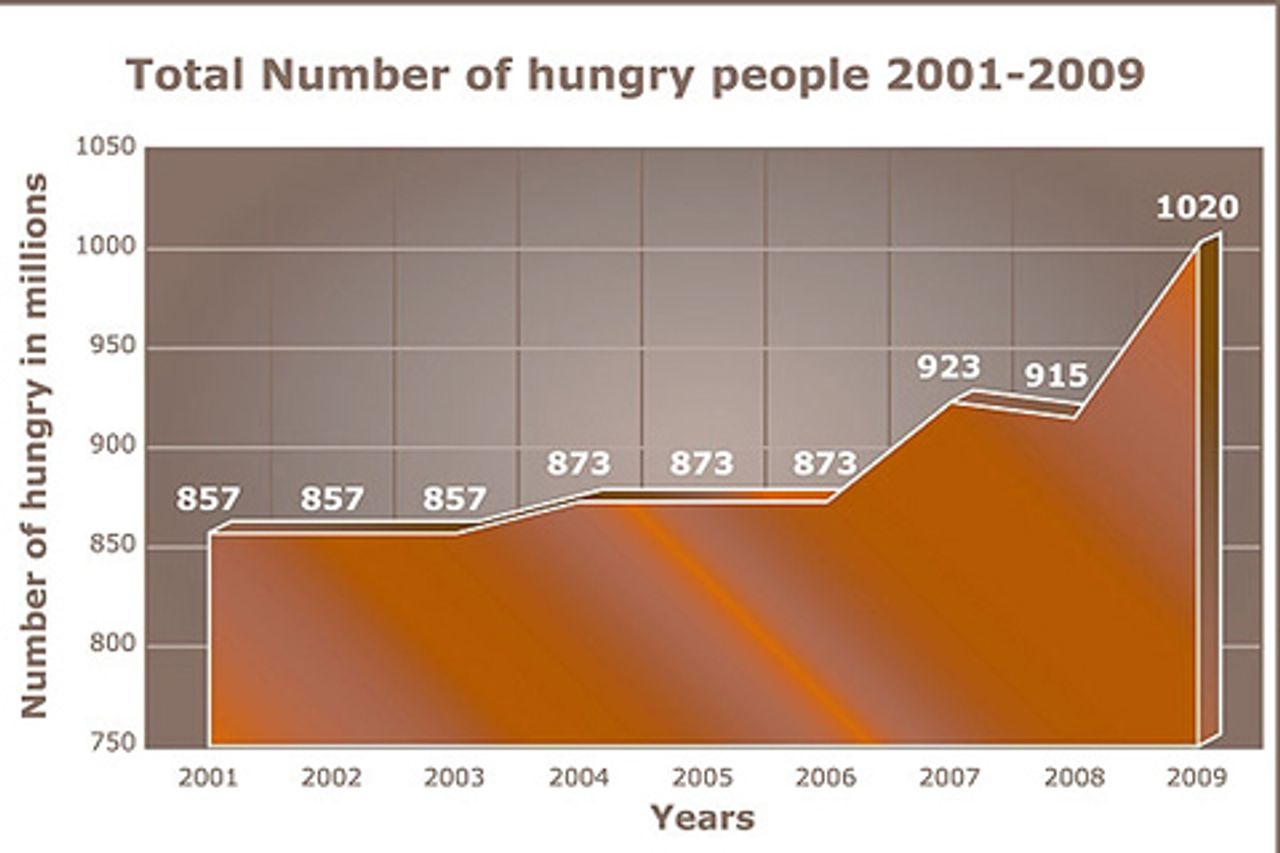
For the first time in history, more than one billion people, or nearly one in every 6 inhabitants of the planet, are going hungry this year, according to a new report from the United Nations’ World Food Program (WFP). Chronic poverty, still high food prices and the impact of the world economic crisis have led to a sharp increase in the number of hungry people, now larger than the combined populations of the United States, Canada and the European Union.

Copyright: WFP/Rein Skullerud

The total number of hungry people has shot up by nearly 200 million over the last decade. After a small decline between 2007 and 2008, world hunger rose sharply as the impact of the economic crisis hit, rising from 915 million in 2008 to an estimated 1.02 billion this year. [See graph]

While disasters, such as floods or droughts, cause temporary food shortages, these emergencies accounted for only 8 percent of the world’s hungry population, the WFP said. Nor is the problem caused by a shortage of food production, which at current levels is sufficient to feed the world’s population.

The source of the catastrophe is the capitalist profit system and, in particular, the continued oppression of the poorest countries in sub-Saharan Africa and Asia. Sixty-five percent of the world’s hungry people live in just six countries: India, China, the Democratic Republic of Congo, Bangladesh, Indonesia, Pakistan and Ethiopia.

The various IMF-dictated “development” programs imposed on these countries have chiefly benefited the banks in London, New York and Tokyo—which have sucked out hundreds of billions in interest payments—as well as the native ruling elites. Falling commodity prices for raw materials have also reduced revenues, while speculation on food has also driven up costs.

According to an article on the WFP report on Livescience.com, aid programs had made certain inroads in fighting hunger at the end of the 20th century. However, rising food prices have all but negated those efforts, causing the number of hungry to rise again everywhere except in Latin America and the Caribbean. The rising cost of food caused the number of hungry to jump by 75 million in 2007 and 40 million in 2008.

“The double whammy of the financial crisis and the still record high food prices around the world is delivering a devastating blow to the world’s most vulnerable,” WFP Executive Director Josette Sheeran told a London press conference Wednesday. “They have been squeezed so much that many have lost what few assets they owned, further exposing them to hunger. Now, it only takes a drought or storm to provoke a disaster.”

The present crisis also underscores the criminal misallocation of financial resources by governments around the world. Sheeren noted that the $3 billion the agency needed to cover its budget shortfall and continue providing food to 108 million people around the world was less than 0.01 percent—or one-hundredth of one percent—the amount spent by world governments on the bailout of the banks and other financial institutions.

While hunger has reached record levels, she said, food aid has fallen to a 20-year low. The WFP said it would have to drastically cut food aid by October because it had only raised less than half of its $6.7 billion budget.

In Kenya, where drought and high food prices have pushed nearly 4 million people into hunger, the WFP said it was preparing to reduce rations.

In Guatemala, its program to provide food supplements to 100,000 children and 50,000 pregnant and lactating women was “hanging by a thread.” Almost half of the children in the Central American country are chronically malnourished—the sixth highest level in the world—and the government has recently declared a “State of National Calamity” due to a shortage of food to feed hungry rural communities.

The WFP reported these stark statistics:

• An estimated 146 million children in developing countries are underweight
• Every six seconds a child dies because of hunger and related causes
• More than 60 percent of chronically hungry people are women

A host of irreversible physical ailments can be caused by undernourishment—the insufficient intake of calories to meet minimum physiological needs—and malnutrition—the lack of sufficient levels of proteins, vitamins and other nutrients.

The most common form of malnutrition is iron deficiency, Livescience.com noted, which affects billions worldwide and can impede brain development. Vitamin A deficiency affects 140 million preschool children in 118 countries and is the leading cause of child blindness. It also kills one million infants a year, according to UNICEF.

Iodine deficiency affects 780 million people worldwide. Babies born to iodine deficient mothers can have mental impairments, the web site noted. Zinc deficiency results in the deaths of about 800,000 children each year and weakens the immune system of young children.

The desperation facing millions produced tragedy Monday when a stampede of people seeking free food in the southern Pakistan port city of Karachi left up to 20 impoverished women and children dead. Officials said they were crushed in a stairwell and alley, as hundreds lined up to get free flour from charity workers.

Police and other witnesses told the Agence France-Presse (AFP) that a private security guard in charge of making sure the women stayed in line charged them with a baton when they became impatient with the long wait. An injured woman, Salma Qadir, 40, said the women wanted to get their rations quickly but were beaten by the guard. “The women got scared and tried to turn back, which scared others and resulted in a stampede,” she told the AFP.

The narrow streets of the market area were reportedly teeming with hundreds of poor people seeking scarce wheat and sugar. Poverty levels in the city of 14 million people have been on the rise along with food prices, which government officials blame on hoarding by mills and large wholesalers. The BBC reported that Pakistan’s government had recently ordered a crackdown against such hoarding, “[b]ut this failed to materialize thus far due to the lobby’s massive influence in Pakistan’s parliament.”

According to the World Food Program, 85 percent of the South Asian country’s 173 million people live on less than US$2 a day. Hunger in the country has been exacerbated by world financial breakdown, skyrocketing food prices and the US-backed war in Pakistan’s North West Frontier Province and tribal areas, which has driven millions from their homes. Currently the WFP is trying to provide daily food rations to 100,000 displaced people in the war-torn area.

http://www.wsws.org/tools/index.php?page=print&url=http%3A%2F%2Fwww.wsws.org%2Farticles%2F2009%2Fsep2009%2Fhngr-s18.shtml

Reply to NYT: Peak Oil is not a theory; Peak Oil is the reality of past and future oil production.

(On August 24, 2009, New York Times published an Op-Ed contribution by Michael Lynch with the title: ‘Peak Oil’ Is a Waste of Energy. Kjell Aleklett, president of ASPO International, has written an answer that NYT decided not to accept. ASPO International is now publishing this contribution.)

Kjell Aleklett, Professor in global energy systems at Uppsala University, Sweden (www.fysast.uu.se/ges) and president of ASPO International (www.peakoil.net).

Over the past five years, Mr. Michael Lynch and I have debated future global oil production at meetings in Gothenburg (Sweden), Paris and Shanghai. We have also conducted the debate through an exchange of emails published in the British journal Science and Public Affairs in December 2008. The arguments that Mr. Lynch advances are, therefore, well known to me. The fact that he is an economist and I am a natural scientist means that we see the future of oil production from two different perspectives, but are in agreement that access to oil is of great importance to the world economy and our future.

What has prompted Mr. Lynch to write his recent opinion piece in the New York Times appears to be a statement from Dr. Fatih Birol of the International Energy Agency (IEA) that Peak Oil is near. At the same time, Mr. Lynch attempts to discredit a number of dedicated and qualified people who work on the Peak Oil issue as well as ASPO, the Association for the Study of Peak Oil&Gas. To suggest that Dr. Birol would base his assertion on “anecdotal information” is astonishing. One wonders what secret information Mr. Lynch possesses and does not wish to share with the IEA.

Oil was formed millions of years ago. Now that the entire world (with the exception of some offshore regions) has been explored to assess its oil resources, we know quite well where the favorable geological structures are located in which oil might be found. We know also that oil resources are unevenly distributed and that more than half of the entire world’s original and its remaining oil is concentrated in the Middle East. Additionally, most of those nations that had lesser quantities of oil have already, at some point in their history, passed the point of peak production. Not even Mr. Lynch can deny that the USA’s year of peak oil production (1970) has come and gone. This fact means that Peak Oil is now reality for the USA. Examining oil production in most of the oil-producing nations outside of the Middle East shows that they have also passed their use-by-date, i.e. they have also experienced Peak Oil.

The claim that the few nations not yet at their maximum production could compensate for other nations’ declining production, while at the same time continuously increasing their own rate of production without reaching Peak Oil and thereby permitting global production to grow for the remainder of this century, is suspect at best. Those who believe this are, primarily, highly educated economists who assert that the peak oil reality that many nations have experienced is nothing but a theory without foundation. On the contrary, there are many well-grounded theoretical models that describe future oil production.

In his article, Mr. Lynch referred to what is known as the “Hubbert model”, a theoretical model that describes quite well the historical and probable future production of oil in the USA. This model characteristically predicts maximum production when half the oil reserves have been produced. For global oil production, there is general agreement that this model does not approximate reality. By studying the production from individual fields in detail, one can see that there are other parameters that have greater importance for the future rate of production. One of these is the proportion of reserves remaining in an oilfield that can be produced every year. We call this parameter “depletion of remaining reserves”. Different fields show different values for this parameter but, for the largest and most important fields, the depletion rate lies somewhere between 4 and 10 percent. When a field reaches a plateau or the maximum depletion rate for its field type, the field’s production thereafter declines by this percentage value year after year. Investments and new technology can slow this trend but the changes in production thus obtained are significantly less than the volumes produced by the field in its heyday.

Nowadays, new projects must be financed with capital from the international finance market, obtained on the basis of a detailed description of geological factors. The IEA, CERA (Cambridge Energy Research Associates) and we at Global Energy Systems (Uppsala University, Sweden), all agree that it is these new projects that will slow the decline in production from existing fields. Uncertainties in the data on old oil fields will not determine the future; rather it will be by the realities that apply when financing must be found for new production.

When is oil discovered in an oil field? At some point the first well must be drilled so that one can state that oil exists underground. Then, to map the total volume of oil, more wells must be drilled. When an oilfield is announced, the entire field is considered to have been discovered although its total structure is not understood. In the BP Statistical Review of World Energy (a publication used by many economists), revisions in the volume of proven reserves in old fields are reported as discoveries in the year the revisions are made, giving the impression that the greatest volume of oil was discovered during the 1980s. However, backdating these revisions to the date of discovery shows that the greatest volume of oil was discovered during the 1960s.

For those observers of this debate who do not understand the details of reserves and production, the arguments can seem chaotic. We at Global Energy Systems always attempt to support our assertions by publishing our scientific analyses in peer-reviewed journal articles. It is these articles that form the foundation for my assertion that Peak Oil is imminent. The current reality seems to be a production plateau with production varying within plus or minus 4% of 85 million barrels per day. The plateau began in 2005 and production may well decline from that point during the next five to ten years. This includes Dr. Birol’s peak oil date.


http://www.peakoil.net/headline-news/reply-to-nyt-peak-oil-is-not-a-theory-peak-oil-is-the-reality-of-past-and-future-oil-p

Thursday, September 17, 2009

Post Peak Living UnCrash Course

We are at the beginning of converging crises, each building on the other: the financial meltdown, peak oil and dramatic climate change. Perhaps with just one we could have managed but the impacts from all three are going to test us in ways we haven't imagined yet. The changes to our lifestyle have already begun and the trajectory is clear. It is now virtually certain that we will watch oil become scarce, crop yields decline, sea levels rise — and our whole financial structure buckle under the strain.

Are you preparing for this perfect storm of global crises? Do you even know how to prepare? Will you simply hunker down or will you see the opportunities to create a new life as well?

http://www.postpeakliving.com/uncrash-course

Our course, led by expert instructors who have been preparing for years, will go beyond preparation and will teach you to become someone who is committed to being a vital member of their community and living a fulfilling life during and after the transition away from fossil fuels. Creating community begins right away as course participants share their knowledge with each other via a private online forum in between course sessions.


Get ready quickly


The instructors have already spent years learning what you need to know and will generously share their knowledge with you. They will tell you the essential skills that are the most valuable to learn now.


Save Money


We'll make sure you don't go down blind alleys we've already investigated or purchase products that won't last or aren't worth the money.


Receive Support Throughout the Course


The course instructors participate in the private forum answering questions and point out additional resources that address your direct question.


Involve the Whole Family


Gather the whole family around the computer to learn new material and afterwards begin working on the homework assignments together.


You can continue to wait for global warming to reduce crop yields, oil to shoot back up over $100 barrel or for deflation or hyperinflation to wipe out the middle class. Or you can start preparing now because you can see that we are all going to experience remarkable lifestyle changes.


In this six week online course, not only will you mentally prepare for a very different world, you will prepare in these key areas:


Health


We have moved the session on Health earlier (to the second week) and have expanded it temporarily to include preparation for the pandemic. The Center for Disease Control is now stating that the best case scenario for this fall's flu season is the following:


  • infection rates up to 50% and a mortality rate of 0.5%; this is similar to the Asian flu, which killed approximately two million people in 1957

  • for comparison, the seasonal flu infects between 10% and 15% of the populace and has a mortality rate of 0.1%


This is not yet commonly known, so we will cover:


  • How to prepare for the pandemic at the same time


  • Practices and products to put in place and purchase now


In addition to the above, you will also learn to prepare for a declining health care system in the medium term due to the collapsing economy:


  • why getting healthy now could make a big difference later

  • key medicines to get while they are widely available

  • alternatives to Western medicine that are clinically proven to work


Skills


As unemployment increases, the formal economy will decline and the informal one will grow. This will require a new set of skills so that you can obtain goods and services. Perhaps paradoxically, it's also an excellent time to start a business. Many imported products will disappear from the shelves leaving room for local manufacturers and repair people.


As we get poorer, we believe most jobs that exist today will disappear. They are a product of an energy abundant world. We'll show you how to navigate the transition period — the period when you have to earn money in the current economy while learning your new skill.


In addition, you will learn:


  • how to select a skill that returns the greatest profit

  • the essential skills everyone should learn


  • how to avoid the pitfalls people fall into while transitioning

  • how to start learning those skills

  • why industrial society will not disappear and how to use that during your preparation


Food


It takes time to learn how to grow food, so we'll get you started right away, plus we'll cover:


  • how the "just-in-time" food system will be impacted by the financial crisis, peak oil and climate change — and how to prepare

  • growing food in suburban and urban environments

  • which kinds of food to grow and what you will need to grow them


  • how to get started with backyard animals like chickens and goats


Transportation


In a world of declining oil, transportation will dramatically change. Find out:


  • how to prepare for sky-high oil prices and oil shortages, which will greatly impact transportation

  • whether we will be driving electric cars or electric bikes, and why


  • which of the new transportation technologies we think are worth purchasing (should you buy an electric car? If so, what do you need to look for during your purchase?)

  • how to get ready for more difficult mobility

  • why even public transportation is going to get more difficult, and how you can prepare for that


Finances and Shelter


As jobs disappear and people watch the prospect of retirement disappear, handling your current wealth will be critical. Also, the nature of shelter is already changing with families and friends moving in with each other; more changes are on the way. In this section, you will learn:


  • what to do with your assets

  • innovative ways to stay sheltered during the transition

  • alternative ways to heat a house

  • the most cost-effective efficiency improvements for a home


Disaster Preparation


As Hurricane Katrina showed us, even in a healthy economy the government will strain to help people recover from disasters. As oil declines, you will need to be resilient and have established a strong community around you. In this section, you will learn:


  • what makes a great earthquake/disaster kit

  • skills to know for a disaster

  • how to create a disaster plan for your family

  • how much food and water you really need


Throughout the course, we'll point out which books to have on your bookshelf, which skills to begin learning now and which products to buy while they are still available (particularly imported ones).


The course textbook is When Technology Fails: A Manual For Self-Reliance, Sustainability, And Surviving The Long Emergency by Matthew Stein.


Instructors


Your course has one of two instructors.


André Angelantoni, BSc.


Civil Engineering


Previously a sustainability consultant who supported over 35 businesses to obtain their Green Business Certification, Mr. Angelantoni is the Co-Founder of Post Peak Living and the author of The Guide to Post Peak Living. He has been preparing for the impact of peak oil and climate change since 2007. He is a registered Federal Emergency Management Agency volunteer (trained for post-earthquake remediation) and has given preparation presentations to business (Sun, eBay, business groups), politicians and citizen groups throughout the San Francisco Bay Area. Mr. Angelantoni also helped found Post Carbon Marin.


Jason Bradford, Ph.D.


Evolutionary and Population Biology


Dr. Bradford is an expert biologist who has been working in Mendocino, CA on relocalization issues for the past four years. He founded WELL (Willits Economic Localization) and has pioneered how to grow food in suburban environments; he harvests rainwater from his roof and runs an organic, commercial farm (see http://www.well95490.org). Dr. Bradford is also the host of The Reality Report, a long-format interview radio show in Mendocino in which he interviews the leading figures in energy and relocalization (click here for past shows). Dr. Bradford was a key advisor in the development of the UnCrash Course curriculum.


When and Where


The courses take place over six weeks on Saturday or Monday mornings from 10am to 1pm PST and occur completely online. There is a 5-minute break at 11am and noon.


The September course will be taught by André Angelantoni and the November course will be taught by Jason Bradford. The dates are:


September 5

September 12

September 19

September 26

October 3


October 10
Or November 2

November 9

November 16

November 23


November 30

December 7

The course is best experienced with an Internet connection, however, we can accommodate people with a single voice line by sending materials ahead of time. You will want a good long distance plan or calling cards or you can use a service such as Skype or Jajah.


Price


The early registration price is $199 until three weeks before the course start date (see the registration page for exact dates). Registration includes all six sessions and forum support. Regular registration is priced at $249.


You must be able to attend the first session and at least four of all six sessions.


All homework is submitted each week for instructor feedback. The homework takes between two and eight hours each week. Please register in the course only if you are willing to commit this amount of time to your preparation. This is not a 'listen-only' course.


Families Learn from Each Other


All course participants get a dedicated online forum to exchange information and accelerate their learning. You will have homework. You do not have to do the homework but considering what is at stake that would be unfortunate.


You are registering per household so that means you can have multiple people attend, including older children (ages 14 and up). We will make the tone light so families can participate and we will concentrate on what do to. If your whole family participates, you will definitely have fun together building gardens, building solar ovens and having conversations over dinner.


It's Crunch Time


Time is the most important thing you have available right now. We strongly urge you to register today.


Extra Coaching


Individual coaching is available from both instructors. Please contact us for more information and rates.


Registration is now open for the fall course and we're looking forward to working with you!


Report of the San Francisco Peak Oil Preparedness Task Force

This seven-member body was charged with coordinating the assessment of San Francisco's vulnerability to energy price shocks, determining appropriate measures to mitigate municipal vulnerability, and to draft a comprehensive response plan for recommendation to the Board of Supervisors. The Task Force released this report and held its final meeting on March 17 2009.

---


From the Executive Summary:


San Francisco was born at the beginning of the oil age, and the city has flourished during an era in which fossil fuels became the foundation of our economy and society. Petroleum and natural gas heat our homes and light our offices; they fuel the trucks that bring us our food and the cars and buses that move us around; they drive our industries and power the information technologies that marvel the world. Today, the City and its inhabitants are utterly reliant on fossil fuel energy: 84% of the energy consumed in San Francisco comes from oil and natural gas.


Because petroleum and natural gas are finite resources, this situation cannot last. If San Francisco is to thrive in the 21st century and remain a world-class city, it must begin planning today for how to maintain itself in a post-fossil fuel age.


The rate at which the globe consumes oil is unsustainable. There is about as much petroleum in the ground as has been pumped out and used up to date - which means we are roughly at the halfway point, or the peak, of global supplies. Except during the oil embargoes of the 1970s and their lingering effects, from the 1880s until 2005, enough oil was produced to keep the price of oil between $15 and $30 per barrel (adjusted for inflation, in 2007 dollars). Since 2005, however, worldwide oil production has been on a plateau, leading to a sudden sharp increase in the price of oil to record-high levels, dropping only because of (and contributing in no small part to) a contraction in the economy of the entire globe.


Eventually, this plateau will turn into an inexorable global decline in oil production. A number of major individual producers have already passed their production peak; the United States was once the largest producer in the world, but has seen falling domestic production since 1971 and now must import more than two thirds of its oil. Outside OPEC, oil production is falling about 3 percent a year. Eventually - regardless of much effort is put into extracting oil from their fields - OPEC too will be unable to resist a steady production decline. It is the prospect of this inexorable decline that is referred to as Peak Oil.


...


As production of oil and natural gas eventually begin to decline, San Francisco will face a painful adjustment - unless it prepares in advance. Experts are divided on exactly when the decline will begin, with some arguing that the peak of production may not occur until as late as the 2030s, and others positing that the peak has, in fact, already happened. Regardless of the exact date of the peak, what is clear is that sooner the City of San Francisco addresses this looming threat and prepares for the difficult transition ahead, the better off the City and its residents will be.


It is the job of the Peak Oil Preparedness Task Force to assess the degree and nature of San Francisco's vulnerability to an eventual, inexorable rise in fuel prices, and ultimately a scarcity in oil and natural gas. Because this report addresses both fuels, it refers to the issue as Peak Oil & Gas.


Impacts


Petroleum and natural gas have become essential to existence as we know it; their scarcities threaten to severely disrupt our quality of life. The most important impacts of Peak Oil & Gas on San Francisco will be:


  • Violent fluctuations in energy prices

  • Rising food prices; possible food shortages

  • Damage to the overall national and local economy

  • Spreading poverty, as the economy contracts

  • Loss of confidence in the future

  • Increasing cost of travel and freight, especially by air; declining air traffic

  • Increasing pressure on public transit

  • Exacerbation of other problems such as climate change and credit contractions


  • Increasing gentrification as the affluent move to the City from the suburbs, displacing those who cannot afford to stay

  • Declining city government revenue, due to

    • generally lower level of economic activity

    • fewer conventioneers and tourists

    • lower revenue-sharing from state and federal governments


Strategies


Addressing these impacts will not be easy. The challenges of reducing our overall reliance on energy from fossil fuels and finding new sources of energy are so enormous that they will require an array of adaptive strategies at every level of government. The most important strategies for the City to pursue are:


Energy:


  • Instruct City agencies and departments that planning must include a scenario of energy decline

  • Implement our city energy buying cooperative, Community Choice Aggregation, and move ahead with the planned efficiency programs and development of electricity based on renewables

  • Encourage the installation of local, renewable, distributed electric generating facilities

  • Pursue the conversion of the electric system to a smart grid


Food:


  • Convert vacant and underutilized public and private properties to food gardens

  • Vastly expand urban agriculture programs and services


Transportation:


  • Expand passenger capacity of all mass transit

  • Avoid infrastructure investments which are predicated on increased auto use

  • Convert City equipment, buses, and trucks to 100% biodiesel from reclaimed lipids, as feasible

  • Discourage private auto use by disincentivizing car travel and ensuring that alternatives (walking, bicycling, public transportation) are competitive with driving

  • Expand the potential for rail and water transport, for both passengers and freight


Recycling:


  • Encourage local manufacturing that utilizes recycled material as feedstock


Buildings:


  • Retrofit the building stock for energy conservation, efficiency and on-site generation


Societal Functioning:


  • Begin an education plan, to inform San Francisco residents about Peak Oil & Gas and its implications


And most importantly, with all of these policies, start now. Conditions will be far better in the long run if the City begins addressing this unfolding challenge immediately. The transition cannot be done quickly; the City faces a limited window of opportunity to begin, after which adaptation will become enormously difficult, painful, and expensive. There is no time to lose.

http://postcarboncities.net/node/4374

What is a Transition Town (or village / city / forest / island)?

Here's how it all appears to be evolving...

It all starts off when a small collection of motivated individuals within a community come together with a shared concern: how can our community respond to the challenges, and opportunities, of Peak Oil and Climate Change?


They begin by forming an initiating group and then adopt the Transition Model (explained here at length, and in bits here and here) with the intention of engaging a significant proportion of the people in their community to kick off a Transition Initiative.


A Transition Initiative is a community (lots of examples here) working together to look Peak Oil and Climate Change squarely in the eye and address this BIG question:

"for all those aspects of life that this community needs in order to sustain itself and thrive, how do we significantly increase resilience (to mitigate the effects of Peak Oil) and drastically reduce carbon emissions (to mitigate the effects of Climate Change)?"

After going through a comprehensive and creative process of:

  • awareness raising around peak oil, climate change and the need to undertake a community lead process to rebuild resilience and reduce carbon

  • connecting with existing groups in the community
  • building bridges to local government
  • connecting with other transition initiatives
  • forming groups to look at all the key areas of life (food, energy, transport, health, heart & soul, economics & livelihoods, etc)
  • kicking off projects aimed at building people's understanding of resilience and carbon issues and community engagement
  • eventually launching a community defined, community implemented "Energy Descent Action Plan" over a 15 to 20 year timescale

This results in a coordinated range of projects across all these areas of life that strives to rebuild the resilience we've lost as a result of cheap oil and reduce the community's carbon emissions drastically.


The community also recognises two crucial points:

  • that we used immense amounts of creativity, ingenuity and adaptability on the way up the energy upslope, and that there's no reason for us not to do the same on the downslope
  • if we collectively plan and act early enough there's every likelihood that we can create a way of living that's significantly more connected, more vibrant and more in touch with our environment than the oil-addicted treadmill that we find ourselves on today.

If you want to find out more, check out the other menu items on the left hand site of the page.


Final point


Just to weave the climate change and peak oil situations together...


  • Climate change makes this carbon reduction transition essential
  • Peak oil makes it inevitable
  • Transition initiatives make it feasible, viable and attractive (as far we can tell so far...)