



Thursday, April 7, 2011


66 Things You Can Grow At Home: In Containers, Without a Garden
Mon Apr 26, 2010 12:55
Growing your own food is exciting, not only because you get to see things grow from nothing into ready-to-eat fruits and veggies, but you also don't have to worry about the pesticides they might contain, and you definitely cut down on the miles they—and you—have to travel.
As it turns out, with pretty minimal effort, anyone can be a gardener. My boyfriend and I are essentially first-timers this season and so far have the beginnings of strawberries peeking out, tomatoes are on their way, the basil's about ready for a big batch of pesto, and once the last frost hits, the peppers, kale, spinach, chard, and mesclun will be on their way, too. All on a tiiiny little terrace (with the help of a little DIY carpentry).

If you're up to the challenge—and it really isn't much of one—growing your own food can be so rewarding. And so much cheaper! Just be sure to choose the right planter or container, learn how to maintain it properly, and go find yourself some seeds! (Or starter plants.) Like this idea? Be sure to check out these 6 Crazy Concepts for Micro Gardens That Actually Work to get inspiration for designing your own garden in a small space. While you're at it, check in with our Organic Gardening feature for tons more info on making your garden grow.
Here's a starter list of all the crazy things even urban gardeners, without space for a garden, can grow at home.

Photo credit: Gardener's Supply
Tree fruits - including apples
1. Apples can be grown in a container; you can also grow them on the balcony or other small space using a technique called espaliering.
2. Kumquats
3. Avocados (plenty of extra tips online if you search)
4. Blackberries
5. Blueberries (sometimes helpful videos are available online)
6. Pomegranate
7. Cherries
8. Figs
9. Pears

Photo credit: Photodisc/Thinkstock
Citrus fruits
Citrus trees in particular are said to be good for beginning gardeners and are easy to grow indoors, so don't let inexperience or lack of outdoor space stop you from enjoying fresh-picked, hyper-local fruit.
10. Dwarf oranges
11. Grapefruit
12. Tangerines
13. Meyer lemons
14. Limes
Tropical fruits
Tropical fruits can also be surprisingly easy to grow indoors, even in non-tropical climates. Such as...
15. Bananas (look for container gardening tips online)
16. Pineapple
17. Papaya
18. Guavas (several varieties)

Photo credit: © iStockphoto.com/Thinkstock
The real surprises
19. Hops—yes, as in the "spice" ingredient in beer. Turns out they're easy to grow!
20. Aloe Vera
21. Strawberries
22. Tea (well, herbal tea)
23. Quinoa!

Photo credit: © iStockphoto.com/Thinkstock
The non-surprises
24. Tomatoes
25. Summer squash
26. Other squashes, like acorn and pumpkin
27. Hot Peppers
28. Sweet peppers
29. Cucumbers
Melons
30. Small cantaloupe
31. Jenny Lind melon (an heirloom cantaloupe)
32. Golden Midget Watermelon

Photo credit: Jupiterimages/Thinkstock
Herbs
Just about any herb grows well indoors—just be sure that if you're going to do any container-sharing, you do your research first about which herbs co-habitate well together. (Some will hog water, for example, and leave the others dried out.)
33. Basil
34. Oregano
35. Parsley
36. Rosemary
37. Chives
38. Catnip
39. Thyme
40. Sage
41. Parsley

Photo credit: Comstock Images/Thinkstock
Leafy Greens
42. Kale
43. Mesclun greens
44. Spinach
45. Swiss chard
46. Lettuces (plenty of options there, from micro-greens to head or loose-leaf)
47. Mustard greens
48. Collard greens
49. Arugula
Root Vegetables
50. Carrots
51. Beets
52. Potatoes

Photo credit: Pixland/Thinkstock
Other healthy-sounding stuff
53. Sprouts
54. More sprouts: mung bean and lentil sprouts
55. Wheatgrass
56. Kohlrabi
57. Turnips
58. Rutabagas
59. Celeriac
60. Parsnips
61. Jerusalem Artichoke
62. Sugar snap peas
63. Rhubarb (not ideal in a container, but it can work)
64. Mushrooms (again, more tips online if you look)
65. Pole Beans
66. Aaaand... asparagus, although some disagree that it does well in a container. Try it if you're ok with a risk!
http://planetgreen.discovery.com/home-garden/sixtysixthings-growhome-containers-withoutgarden.html
BP says feds could base spill fines on days, not barrels
HOUSTON CHRONICLE
April 6, 2011, 4:07PM
BP says the U.S. government could calculate any criminal fines for last year's Gulf oil spill based on how many days the Macondo well flowed rather than on how many barrels of crude leaked.
In court filings Tuesday, the oil giant responded to a lawsuit filed in December by the Department of Justice that seeks civil environmental penalties based on an estimated 4.1 million barrels of oil that spilled into the Gulf after the explosion and sinking of the Deepwater Horizon rig on April 20, 2010, killing 11 workers.
The well was capped July 15 and permanently sealed Sept. 19.
Federal officials said in their lawsuit that they would seek civil penalties of $1,000 to $4,300 per barrel based on whether it was determined there was willful negligence involved in the accident.
BP said in the court filings it was not willfully negligent and that federal officials can use a different method for assessing fines under the Clean Water Act — levying a fixed fine for every day the well flowed. That fine is $32,500 per day.
Using the daily figure fines could run from $2.8 million to $4.9 million, depending on whether one uses the date the well was capped or permanently sealed. The per-barrel figure could lead to fines ranging from $4.1 billion to more than $20 billion.
BP's partners in the well, Anadarko Petroleum Corp. and MOEX Offshore, a unit of Japan's Mitusi, also filed papers in court this week denying they acted negligently or engaged in willful misconduct.
BP said in its filings it believes the other companies should share remediation costs and fines, and that cleanup and restoration costs the U.S. charges BP should be reduced by whatever sums BP has paid or will pay state governments for those same services.
http://www.chron.com/disp/story.mpl/business/energy/7508609.html
April 7th Action - Dear Congress: I Pay Taxes, I Did Not Cause the Recession.
CLICK HERE to send this letter to your senators and representative.
I Pay Taxes, I Did Not Cause the Recession
Dear Congress,
Please remember: you are fighting over how to spend our money. We the People pay 33.7% of the Federal Fund while corporations pay 7.2%. Many corporations pay no taxes at all. Yet your entire focus during this budget battle has been on how much to hurt the people.
We did not cause the recession, the deficit, or the national debt. We know this, and we need you to know that we are aware of a corrupt system in which corporations spend their vast wealth to lobby and manipulate you.We know that's why the tax code so unjustly burdens us while favoring them. We know this is why Elizabeth Warren and the Consumer Financial Protection Bureau are under attack from the US Chamber of Commerce and other powerful lobbyists. We know that is why your policies reward multinational corporations, including those that DID cause the recession, with bailouts, bonuses, and tax benefits.
As you wrangle over how much to hurt our quality of life and jeopardize our future, consider ways to create jobs and invest in our future.
Congress should work together on how to help us, not fight over how to hurt us.
Sincerely,
_______________________
To send this letter (or your personalized version) to your Members of Congress, click CLICK HERE. If you get a message saying "No Congress Member found in your area," click the "participate" button again.
http://www.coffeepartyusa.com/congress-taxpayer
Gov. Scott Walker Chose Top Donor’s 26-Year-Old Dropout Son Over PhD And Engineer
On Monday, ThinkProgress noted that Gov. Scott Walker (R-WI) was using state funds to pay more than $81,500 a year to Brian Deschane, a 26-year-old son of a major campaign donor with no college degree and two drunken-driving convictions. The job involved overseeing state environmental and regulatory issues and managing dozens of Commerce Department employees.
Yesterday, after the media reported on the hiring, Walker abruptly reversed course and removed Deschane from his position. Despite calling Deschane a “natural fit” just last week, Walker spokesman Cullen Werwise said Tuesday that the Governor decided “to move in another direction” after learning of the details of the appointment.
Yet, Deschane will still serve in the Administration, returning to his previous job where he made $64,000 a year. Assembly Minority Leader Peter Barca (D) says he continues to be “concerned about whether [Deschane] was hired properly under the civil service system.”
Those concerns appear to be well-founded. The Milwaukee Journal Sentinel reveals that Walker Commerce Secretary Paul Jadin choose Deschane as head of environmental and regulatory affairs at the Commerce Department over two highly qualified former state officials with extensive experience in state government:
The first [potential candidate] Oscar Herrera, is a former state cabinet secretary under Republican Gov. Scott McCallum with a doctoral degree and eight years’ experience overseeing the cleanup of petroleum-contaminated sites.
The second, Bernice Mattsson, is a professional engineer who served since 2003 in the post to which Deschane was appointed.
Herrera and Mattsson didn’t get far in the process.
“Neither candidate was interviewed,” said agency spokesman Tony Hozeny. [...]
Still, Hozeny said, Herrera and Mattsson expressed an interest in the job of administrator of the Division of Environmental and Regulatory Services.
The scandal comes amidst a larger effort by Walker to strip the Department of Commerce of its regulatory and environmental functions and transform the Department “into a public-private hybrid in charge of attracting and retaining businesses.”
– Kevin Donohoe
http://thinkprogress.org/2011/04/06/scott-walker-dropout-hire-update/
Chris Abele Elected Milwaukee County Executive In Blow To Scott Walker
Chris Abele has won the race for Milwaukee County Executive, defeating Republican Jeff Stone handily on Tuesday. The position was previously held by Wisconsin Governor Scott Walker (R), whose controversial anti-union law has sharply divided the state.
Abele won more than 60% of the vote.
Abele used the recent controversy surrounding Walker to build support for his campaign. The Milwaukee Wisconsin Journal Sentinel reports that "he [Abele] put much of his advertising firepower into trying to fuse Stone with Gov. Scott Walker and his controversial push to end most collective bargaining for public employees."
WISN in Milwaukee reports that Abele only recently came into prominence, explaining that he "was fairly unknown until about four months ago except in philanthropic circles."
The Journal Sentinel details how Abele ran his campaign:
Though a longtime supporter of Democratic candidates and liberal causes, Abele ran for county executive - officially a nonpartisan office - often sounding like a conservative. Like Stone, Abele vowed not to raise taxes and said he'd work hard to attract new business. Abele said he'll push to wipe out inefficiencies and service duplications and might turn to privatizations, selling off county assets and marketing park services to the suburbs.
A tightly contested Supreme Court race is still undecided in the Badger State.
http://www.huffingtonpost.com/2011/04/06/chris-abele-milwaukee-county-executive_n_845347.html
Scott Walker’s Attorney Says Justice David Prosser Is Vital To Anti-Worker Agenda
The success of Wisconsin Gov. Scott Walker’s anti-worker agenda is hinging on the outcome of the state Supreme Court election, according to an e-mail sent to Walker’s supporters by his chief counsel, Brian Hagedorn.

The race is currently too close to call, with challenger JoAnne Kloppenburg holding a 309-vote lead over Walker ally Justice David Prosser with five precincts left to report.
Prosser originally billed his reelection campaign as being about “protecting the conservative judicial majority and acting as a common sense complement to both the new [Walker] administration and Legislature.” Recently, however, he has attempted to claim independence. But Hagedorn’s e-mail laid it plain to Walker’s supporters: elect Prosser, or the governor’s agenda is in peril. From the e-mail:
“If Justice Prosser loses:
* The Supreme Court will shift from a 4-3 conservative majority to a 4-3 liberal majority.
* Governor Walker’s agenda could be stopped in its tracks by this new activist majority.
* Union bosses and their allies will be emboldened and further push to recall the brave Senators who voted for Governor Walker’s budget repair bill.
* (Chief Justice) Shirley Abrahamson and her allies will continue to drag down the reputation of the Court, with an additional vote to further push through their radical agenda.”
The last few weeks have been rough on Walker. His anti-union “budget” bill was held up in court. Union leaders filed a recall petition against one Republican member of the state Senate, with as many as seven more potentially coming. Yesterday, Wisconsin voters offered a referendum on Walker at the ballot box, soundly defeating his hand-picked candidate in the race for his old seat as Milwaukee County Executive. And the Supreme Court race, where Prosser was a clear favorite coming out of the primary, now appears headed for a recount.
http://thinkprogress.org/2011/04/06/david-prosser-walker-anti-worker/
Paul Ryan’s Multiple Unicorns
April 6, 2011, 9:00 am
Gosh. For a plan that supposedly sets a new standard of seriousness, Paul Ryan’s vision (pdf) depends an awful lot on unicorn sightings — belief in the impossible. Let me review the top three unicorns.
First, the plan assumes that tax cuts will set off a literally unprecedented boom. Here’s again, is what is assumed about unemployment:
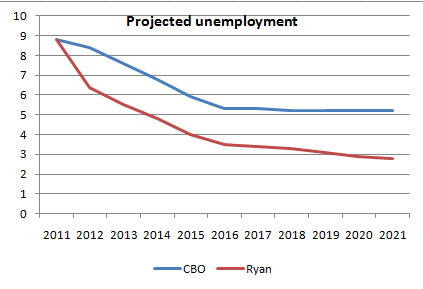 House budget proposal
 So Ryan is claiming that unemployment will plunge right away; that by 2015 it will be down to the levels at the peak of the 1990s boom (and far below anything achieved under the sainted Ronald Reagan); and that by 2021 it will be below 3 percent, a level we haven’t seen in more than half a century. Right.
Then there’s the Medicare business. According to the CBO analysis, a typical senior would end up spending more than twice as much of his or her own income on health care as under current law. As Dean Baker points out, this means that seniors would end up paying most of their income for health care. Again, right.
But in a way, the worst part isn’t the Medicare plan: it’s the fact — which so far has not penetrated the debate — that the biggest source of supposed savings in the plan isn’t actually health care, it’s an assumption that federal spending on everything except health and Social Security can somehow be squeezed, as a percent of GDP, to a small fraction of current levels. Here’s the table, from Ryan’s own report:

Notice the marked area at the bottom: Ryan is assuming that everything aside from health and SS can be squeezed from 12 percent of GDP now to 3 1/2 percent of GDP. That’s bigger than the assumed cut in health care spending relative to baseline; it accounts for all of the projected deficit reduction, since the alleged health savings are all used to finance tax cuts. And how is this supposed to be accomplished? Not explained.
This isn’t a serious proposal; it’s a strange combination of cruelty and insanely wishful thinking.
http://krugman.blogs.nytimes.com/2011/04/06/paul-ryans-multiple-unicorns/

